Choosing the right transformer capacity is essential for reliable industrial power distribution. This guide covers standard 3 phase transformer sizes, common kVA ratings, and how to select the right size for your project.
What Are Standard 3 Phase Transformer Sizes?
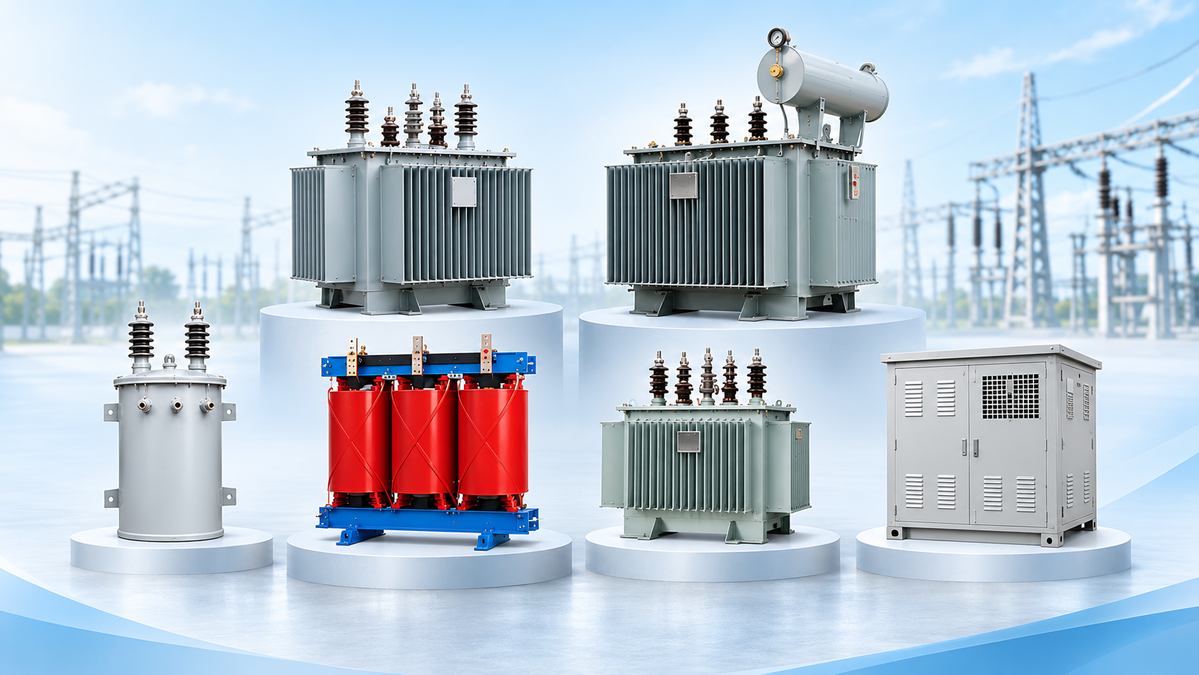
Three-phase transformers come in a range of rated capacities to meet different power distribution requirements. Their sizes are usually expressed in kVA or MVA, depending on the power level and application.
What Does a Transformer kVA Rating Mean?
A transformer’s kVA rating represents its apparent power capacity. To understand this, it is important to distinguish between three electrical power measurements:
kW (Kilowatts): Real power used to perform useful work, such as running motors and industrial equipment.
kvar (Kilovolt-Amperes Reactive): Reactive power associated with maintaining electric and magnetic fields in AC systems.
kVA (Kilovolt-Amperes): Apparent power, which combines real and reactive power.

Do Standard Transformer Sizes Vary by Market?
Yes. Common three-phase transformer ratings vary by region, voltage class, and application. North American products commonly reference ANSI/IEEE standards, while many other markets use IEC standards.
North American Market
Common rating examples
75 / 112.5 / 150
225 / 300 kVA
ANSI/IEEE-oriented product ranges
IEC-Oriented Markets
Common rating examples
100 / 160 / 250
400 / 630 kVA
IEC-oriented product ranges
These are illustrative product ratings, not mandatory sizes under either standard. Actual availability depends on the manufacturer’s product range.
Always verify the required kVA rating, voltage, frequency, and applicable standards before ordering.
Standard 3 Phase Transformer Sizes and kVA Ratings
Standard 3 phase transformer sizes vary by application, voltage class, and manufacturer. The following tables show common three-phase transformer kVA ratings to help engineers and procurement teams compare available capacities.
Common Low-Voltage Three-Phase Transformer Sizes
Low-voltage three-phase transformers are widely used in commercial buildings, workshops, and industrial facilities. Common North American catalog ratings range from 15 to 750 kVA.
SMALL CAPACITY
15–75 kVA
Common Ratings
15 / 30 / 45 / 75
Workshops and small commercial facilities
MEDIUM CAPACITY
112.5–300 kVA
Common Ratings
112.5 / 150 / 225 / 300
Commercial buildings and industrial equipment
LARGE CAPACITY
500–750 kVA
Common Ratings
500 / 750
Large facilities and industrial distribution
Note: These are common North American catalog ratings. Available sizes vary by manufacturer, voltage, and configuration.
Common Medium-Voltage Three-Phase Transformer Sizes
Medium-voltage three-phase transformers commonly step down 10 kV, 11 kV, 20 kV, or 33 kV supplies for industrial and commercial distribution. Common kVA ratings vary by regional standards, utility requirements, and transformer design.
| Capacity Group | Common kVA Ratings | Typical Applications |
| Small Distribution | 100, 160, 250, 315 kVA | Small factories and local distribution networks |
| Medium Distribution | 400, 500, 630, 800, 1000 kVA | Commercial complexes and industrial facilities |
| Large Distribution | 1250, 1600, 2000, 2500 kVA | Large industrial plants and high-demand distribution systems |
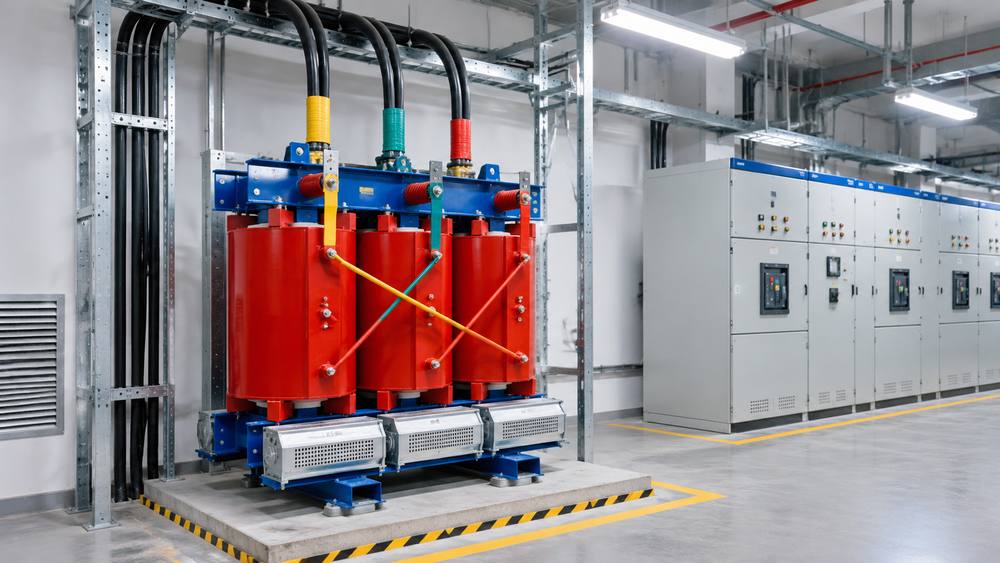
For indoor installations, explore our Cast Resin Dry Type Transformer. For outdoor utility and industrial distribution, see our Distribution Oil Immersed Transformer.
North American vs IEC Rating Examples
Three-phase transformer ratings vary by market. The examples below highlight common capacity selections and electrical specifications.
North American Market — IEEE C57
75 · 112.5 · 150 · 225 · 300 kVA
Frequency: 60 Hz
LV: 208Y/120 V, 480Y/277 V
IEC-Oriented Markets — IEC 60076
100 · 160 · 250 · 400 · 630 kVA
Frequency: 50 / 60 Hz
LV: 400/230 V, 415/240 V
Selection Tip: Confirm the required capacity, primary and secondary voltages, frequency, and applicable standards before ordering. Actual ratings and configurations depend on the transformer type and project requirements.
Three-Phase Transformer Size Chart: kVA and Full-Load Current
Explain how transformer capacity relates to full-load current at different three-phase voltage levels.
Full-Load Current Reference Chart
| kVA | 208V (A) | 400V (A) | 480V (A) |
| 30 | 83.3 | 43.3 | 36.1 |
| 45 | 124.9 | 65.0 | 54.1 |
| 75 | 208.2 | 108.3 | 90.2 |
| 112.5 | 312.3 | 162.4 | 135.3 |
| 150 | 416.4 | 216.5 | 180.4 |
| 225 | 624.5 | 324.8 | 270.6 |
| 300 | 832.7 | 433.0 | 360.8 |
| 500 | 1387.9 | 721.7 | 601.4 |
| 1000 | 2775.7 | 1443.4 | 1202.8 |
How to Use the Transformer Size Chart
Practical Transformer Sizing Example
PROJECT DATA
VOLTAGE
208 V
CURRENT
175 A
PHASE
Three-phase
CALCULATION
Three-phase apparent power formula
kVA = (1.732 × V × I) ÷ 1,000
Calculation:
kVA = (1.732 × 208 × 175) ÷ 1,000
63.05 kVA
Transformer Sizing Examples
Transformer sizing depends on the calculated load, power factor, operating voltage, and expected future demand. The following three examples demonstrate how engineers calculate the required kVA and select an appropriate three-phase transformer rating.
01. Commercial Building – 80 kW Load
A commercial building has a calculated maximum demand of 80 kW, a power factor of 0.90, and a planned expansion allowance of 15%.
Load Calculation
Required kVA = kW ÷ Power Factor
80 ÷ 0.90 = 88.89 kVA
Including Future Expansion
88.89 × 1.15 = 102.22 kVA
Indicative Transformer Selection
Select the next available rating above 102.22 kVA, such as 112.5 kVA under an applicable ANSI rating series or 125 kVA under an IEC preferred rating series.
02. Industrial Equipment – 400 V, 360 A
A manufacturing facility requires a balanced three-phase power supply at 400 V, with a maximum operating current of 360 A.
Load Calculation
Three-Phase kVA = (√3 × Voltage × Current) ÷ 1,000
(1.732 × 400 × 360) ÷ 1,000 = 249.4 kVA
Indicative Transformer Selection
A 250 kVA transformer may be suitable where this rating is available for the required voltage configuration. Otherwise, select the next higher available rating.
Motor starting current and load fluctuations should also be evaluated before final selection.
03. Large Industrial Facility – 450 kW Load
A large industrial facility has a calculated maximum demand of 450 kW, a power factor of 0.90, and an approved future expansion allowance of 20%.
Load Calculation
450 ÷ 0.90 = 500 kVA
Including Future Expansion
500 × 1.20 = 600 kVA
Indicative Transformer Selection
A 630 kVA transformer may be selected where this rating is available in the required voltage configuration.
For a 400 V three-phase secondary, the rated full-load current is approximately 909 A.
Frequently Asked Questions
Common ratings include 100, 125, 160, 200, 250, 315, 400, 500, and 630 kVA. Available sizes vary by market and manufacturer.
Use: kVA = (√3 × Voltage × Current) ÷ 1,000 for a three-phase system.
Calculate the maximum load, consider power factor and future expansion, then select an appropriate available rating.
Yes. Higher voltage means lower rated current at the same kVA capacity.
Provide rated capacity, primary and secondary voltage, frequency, application, and installation conditions.
kVA represents apparent power, while kW represents active power. The relationship depends on the load power factor.
Yes, if the voltage, operating conditions, and load characteristics are suitable. The transformer will have approximately 20% spare capacity at a 400 kVA load.
An undersized transformer may experience overheating, excessive voltage drop, and reduced service life.