Industrial automation has become an inevitable trend in global manufacturing upgrading. As the two core components of modern industrial control systems, PLC (Programmable Logic Controller) and SCADA (Supervisory Control and Data Acquisition) platforms undertake the core functions of on-site logic control and full factory data monitoring. Combined with IIoT industrial IoT technology, they build a closed-loop industrial automation system of “on-site execution + edge transmission + cloud management”.
Many industrial enterprises still use discrete single-device control modes, resulting in poor equipment collaboration, inconvenient remote debugging, and low production management efficiency. Optimizing the PLC and SCADA system architecture is the key to improving factory automation and intelligent level.
1. Core Functions of PLC in Industrial Electrical Automation
PLC controllers have the advantages of strong anti-interference, stable operation, and flexible programming, and are widely used in two major industrial scenarios:
2. How SCADA Platform Realizes Full Factory Centralized Monitoring
SCADA platform solves the pain point of industrial equipment data isolation, and is the core data management carrier of industrial control systems:
- Real-time Data CollectionThrough standard industrial protocols such as Modbus and OPC UA, it synchronously collects operating data of all on-site PLCs, power instruments, sensors, and frequency converters.
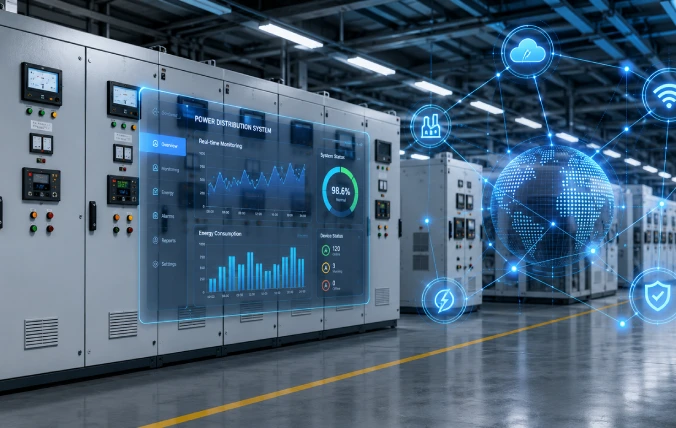
- Visualized MonitoringRestore the real scene of the workshop production line and power distribution room through digital twin images, mark abnormal data in real time, and pop up alarm prompts.
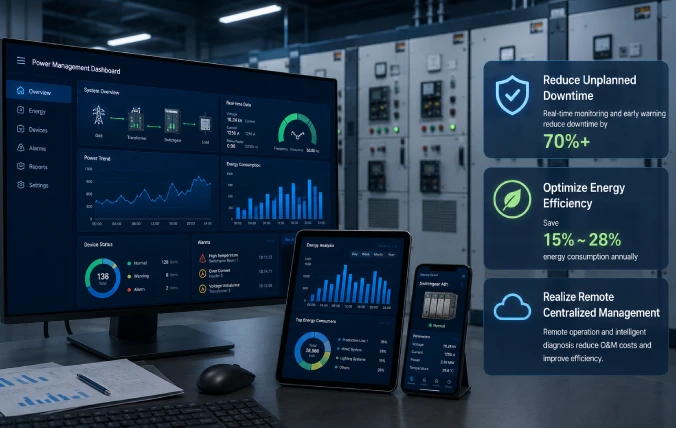
- Remote Operation and MaintenanceSupport remote parameter adjustment, program upload and download, and equipment start-stop control, realizing cross-region remote management of multi-branch factories.
- Data Analysis and StatisticsAutomatically store operating data, generate production reports and energy consumption reports, and provide data support for enterprise production decision-making and energy audit.
3. PLC + SCADA + IIoT Three-Linkage Intelligent Control Architecture
The combination of local PLC control, cloud SCADA monitoring, and IIoT edge gateway transmission forms the most mature industrial automation solution at present:
This architecture supports non-intrusive transformation of old factories, no need to replace existing power distribution equipment and production lines, which greatly saves the cost of industrial digital upgrading.
4.Industry Application and Selection Standards
Different industrial scenarios correspond to different PLC and SCADA configuration schemes: discrete manufacturing adopts modular medium-sized PLC + touch screen HMI + cloud SCADA; new energy power stations adopt high-stability special PLC for power distribution; small and medium-sized factories adopt economical small PLC systems to realize low-cost automation upgrading.
When selecting equipment, it is necessary to focus on protocol compatibility, on-site environmental adaptability, system expandability, and data security to ensure the long-term stable operation of industrial control systems.
Conclusion
PLC and SCADA systems are the cornerstone of industrial electrical automation. With the empowerment of IIoT industrial IoT, they have realized the upgrade from single equipment control to full factory intelligent management, helping enterprises reduce costs, improve efficiency, and enhance market competitiveness.
Henan Automation Control Technology Co., Ltd. provides customized PLC control cabinets, industrial SCADA monitoring platforms, and IIoT supporting equipment, providing one-stop services from scheme design, programming debugging to on-site installation. Get professional industrial control system selection guidance now.